
Presenters: Carl Felger and Jeff Eiber
Focus: Analysis of GPS tracking and race telemetry from the Thistle National Championship in Eugene, Oregon to identify the biggest factors separating top-performing boats from the rest of the fleet.
Focus: Analysis of GPS tracking and race telemetry from the Thistle National Championship in Eugene, Oregon to identify the biggest factors separating top-performing boats from the rest of the fleet.
Executive Summary
The webinar challenged one of the most common assumptions in sailing:
The boats at the back of the fleet are generally not much slower than the boats at the front.
Analysis of RaceSense data from 57 boats at the Thistle Nationals revealed that the primary difference between top and bottom performers was not boat speed, but the amount of extra distance sailed around the racecourse.
The strongest conclusion was:
Most sailors would gain more places by sailing a more efficient course than by finding small increases in boatspeed.
For sailors in the bottom half of the fleet, simply reducing unnecessary distance sailed could have improved standings by an average of five positions without increasing speed.
Key Findings
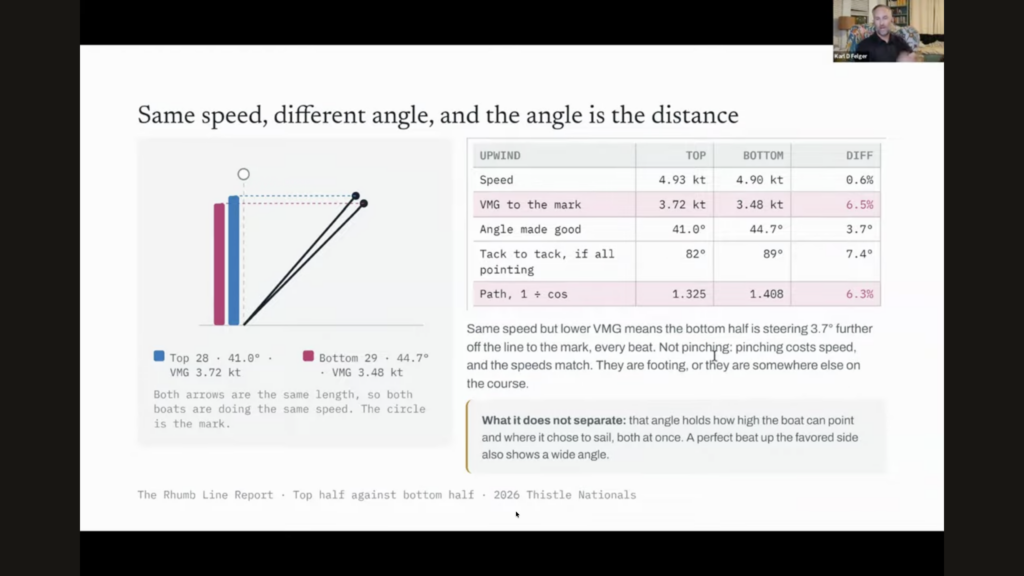
1. Boat Speed Was Nearly Identical
When the fleet was divided into the top and bottom halves:
|
Metric
|
Top Half
|
Bottom Half
|
|---|---|---|
|
Average Upwind Speed
|
4.93 knots
|
4.90 knots
|
|
Difference
|
0.6%
|
The difference is statistically negligible.
Major Insight
Many sailors assume:
- Better sailors point higher because they sail faster
- New sails create huge speed gains
- Expensive equipment produces major performance advantages
The data did not support those assumptions.
Most competitors already had comparable speed.
The issue was:
The fastest boats got around the course more efficiently.
2. Distance Sailed Was the Real Separator
The winning boats sailed significantly less distance.
Average Extra Distance
|
Group
|
Distance Behind Leader
|
|---|---|
|
Top Half
|
339 m
|
|
Bottom Half
|
725 m
|
The bottom half sailed:
114% more extra distance than the top half.
Converted to Thistle lengths:
- 400 meters ≈ 77 boat lengths
Visualizing 77 extra boat lengths highlights why finishing positions suffer dramatically despite similar speed.
3. Speed Is Not the Same as VMG
A major educational point in the webinar was understanding:
VMG (Velocity Made Good)
VMG measures how effectively a boat moves toward the next mark.
A boat can:
- Sail fast
- Feel fast
- Generate good boatspeed
Yet still lose distance if it is sailing at a poorer angle.
Carl emphasized:
“Speed is not the same as VMG.”
The most successful boats:
- Maximized their angle toward the mark
- Stayed on lifted tacks
- Minimized time sailing away from the mark
4. The Front of the Fleet Sailed Better Angles
Analysis showed that boats in the back half sailed approximately:
3.7 degrees lower than optimal
On both tacks this translates to roughly:
7.4 degrees of total VMG loss
Small angle differences create large distance losses over a full weather leg.
This suggests many sailors are:
- Over-footing
- Staying on headers too long
- Sailing extra distance to maintain speed
- Failing to return quickly enough to a favored tack
5. Better Sailors Tack More Frequently
One surprising insight:
Average Maneuvers
Top half of fleet
- Approximately 45-50 maneuvers per race
Bottom half
- Approximately 30-45 maneuvers
Interpretation:
The best sailors were:
- Reacting to shifts sooner
- Tacking on headers
- Getting onto lifted tacks faster
- Continuously adjusting to course conditions
The front of the fleet was actively managing VMG rather than simply sailing longer straight lines.
6. The First Beat Was Critical
Perhaps the most actionable finding of the entire webinar:
Biggest Losses Occurred on the First Beat
The first weather leg generated substantially larger losses than later legs.
Reasons include:
Congestion
Immediately after the start:
- 57 boats are fighting for lanes
- Dirty air is everywhere
- Clear air is difficult to find
Poor Starts Compound Quickly
A weak start often leads to:
- Losing lane control
- Being rolled by other boats
- Being forced into clearing tacks
- Sailing headers
- Sailing farther
- Losing more distance
By the second and third beats:
- Fleet spread is greater
- Clean air is easier to find
- Tactical mistakes carry smaller penalties
7. Starting Matters More Than Many Sailors Think
The presenters found strong evidence linking performance with:
Being Closer to the Line
Boats in the top half typically:
- Started closer to the line
- Had greater speed at the gun
- Held lanes better
Boats in the bottom half often:
- Started behind the line
- Accelerated late
- Lost lane immediately
This created a chain reaction leading to extra distance sailed.
Aggressive Starts Are Better Than Timid Starts
Jeff Eiber noted:
“If you’re regularly having poor starts, push harder.”
The data suggested:
- An occasional OCS is less damaging than consistently starting several boat lengths behind the line.
8. Clear Air Is Everything
Many distance losses could be traced back to choices forced by bad air.
Typical sequence:
- Poor start
- Lose lane
- Forced tack for clear air
- Tack into a header
- Sail farther from the mark
- Lose significant VMG
The presenters repeatedly returned to the importance of:
- Starting in a position to hold a lane
- Protecting clean air
- Returning to the favored tack as quickly as possible
9. Downwind Was Not the Major Problem
Many sailors assume downwind speed is where they lose races.
The data suggests otherwise.
Key observations:
- Little separation existed in downwind speed among the back half of the fleet.
- Most major losses occurred upwind.
- The largest gains were available on the first beat.
Carl summarized:
If you think your biggest problem is downwind speed, the data says you’re probably wrong.
The priority should be:
- Starts
- First weather leg
- Clear air
- VMG management
before focusing heavily on downwind refinement.
10. Simulation: What Happens If Distance Is Reduced?
Carl adjusted the data and asked:
What if boats sailed the same speed but reduced extra distance?
Result:
Average gain = approximately 5 places in the final standings.
No speed increase.
No new sails.
No new boat.
No rig changes.
Just better tactical efficiency and course management.
Practical Coaching Recommendations
Based on the findings, Carl’s coaching priorities would be:
1. Practice Starts
Focus on:
- Time-to-line accuracy
- Holding position
- Accelerating on demand
- Crossing the line at speed
2. Sail the First Beat for Position
Rather than obsessing about speed:
Focus on:
- Clear air
- Lifted tacks
- Maintaining lanes
- Avoiding forced clearing tacks
3. Return to the Favored Tack Quickly
After clearing:
- Don’t stay extended too long
- Get back onto the lifted tack
- Resume maximizing VMG
This was one of Jerry’s key personal takeaways.
4. Train Tactical Awareness
Have the crew help monitor:
- Shifts
- Pressure
- Competitors
- Developing lanes
Jeff emphasized:
Three brains are better than one.
Middle and forward crew should actively contribute to tactical decision-making.
5. Use Regattas as Practice Opportunities
Carl recommended treating some regional regattas as developmental events:
Experiment with:
- Starting techniques
- Lane management
- Tactical decision processes
Even if it costs a few results short-term.
Memorable Quotes and Concepts
“The back half of the fleet is not slow. They’re just sailing farther.”
The central message of the webinar.
“Speed is not the same as VMG.”
Sailing efficiently toward the mark matters more than raw boatspeed.
“Sail the first beat for position, not for speed.”
The largest opportunities to gain or lose occur immediately after the start.
“The less time you spend on the racecourse, the better you’re doing.”
Carl’s sailing version of a golf analogy.
Key Takeaways for a Thistle Sailor
If you only remember five things from the webinar:
- Your boatspeed is probably better than you think.
- The biggest gains come from sailing less distance, not sailing faster.
- Starts and the first beat matter more than any other part of the race.
- Stay in clear air and get back to the lifted tack quickly.
- Improving VMG and tactical positioning can gain more places than new equipment.
The webinar’s overall message was encouraging:
Most sailors do not need a faster boat. They need a more efficient racecourse. The path to better results is primarily tactical rather than technological.


